Original retro consoles · Editorial field guide
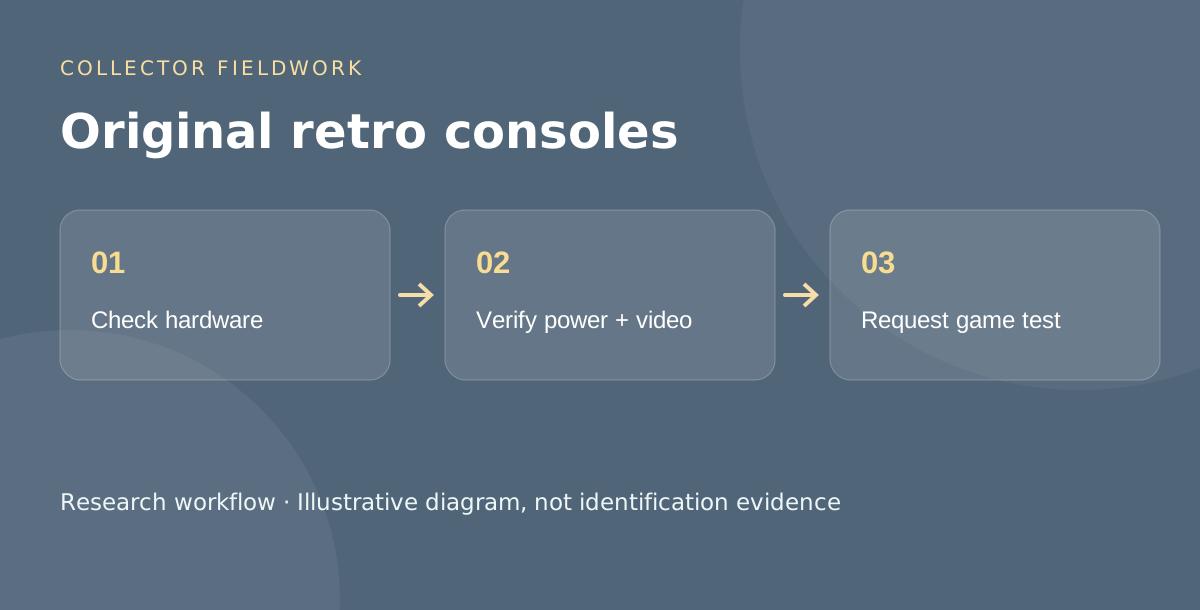
Buying an Untested NES: What to Ask About Video and Cartridge Reads
Affiliate disclosure: Some marketplace links earn a commission if you buy. Listings are seller descriptions—not independent authentication or proof of value.
Quick answer. A power light is not a full demonstration. Buyers should ask for a recognizable game image, sound, controller response and the exact cables used. The practical goal here is seller demo request, cables, controllers and shell condition, while keeping uncertain details visibly uncertain.
This guide is for someone handling particular hardware revision and tested bundle—whether deciding what to buy, documenting a family find, or preparing a defensible sale description. The key is to investigate the exact example rather than relying on a broad category name.
What to establish first
The question: Seller demo request, cables, controllers and shell condition. This is more specific than “Is it rare?” or “Is it worth anything?” because it can be answered from recorded evidence. A power light is not a full demonstration. Buyers should ask for a recognizable game image, sound, controller response and the exact cables used.
Before spending time on a valuation, establish which version or condition is actually involved. The practical risk is plugging unknown-voltage imports into mains, or trusting “tested” without a game/demo. Neither age nor an attractive seller story resolves that uncertainty.
In-depth field guide
An original Nintendo Entertainment System sold as “untested” might need only an appropriate cable and a clean game, or it might have faults that are difficult or uneconomical to repair. Online sellers often use the term because they lack the accessories to demonstrate operation. The buyer's job is to separate missing evidence from a known defect.
Identify what is actually included
Ask for photographs of the console's top, bottom, rear, controller ports, cartridge opening, power jack, and model label. Request a complete picture of the included cables, controllers, and games. Do not assume a photograph of a console beside a controller means the controller is included.
If the seller claims the console is a particular region or revision, use the model label and connector configuration as evidence. Voltage and video standards can differ by market. Never connect an unidentified power adapter simply because its plug fits.
What a meaningful demonstration looks like
A useful test shows the same physical console connected to a known-compatible display and appropriate power source, booting more than one known-working game if available. Ask for footage that includes startup, image, sound, controller input, and a short period of stable operation. A single still photograph of a title screen does not tell you whether the device runs reliably.
If the seller has no games, cable, or television, that is understandable—but “untested” then means untested. Treat the item as a repair-risk purchase and price it accordingly.
Look closely at the cartridge slot
Request a well-lit photograph of the opening and accessible connector area. Bent or damaged contacts, heavy corrosion, foreign material, or obvious modifications deserve questions. Cartridge-read problems can have multiple causes, including dirty games, worn contacts, or hardware faults. Do not diagnose the specific defect from one blurry listing picture.
Avoid advising a stranger to disassemble the console, use harsh solvents, or repeatedly force cartridges into a questionable slot. For an expensive collectible, a competent technician's assessment is a better path than speculative repair instructions.
Cosmetic originality versus functionality
Discoloration, cracks, missing feet, chipped plastic, torn labels, and replacement shells affect collector presentation. A refurbished machine may play better while being less original. Ask whether components, the case, or internal hardware were replaced, and request documentation for claimed professional service.
For some buyers a reliable player console matters most; for others, an intact original package and matching serial details are central. Determine which goal you have before paying a premium.
Calculate the full purchase
Add purchase price, shipping, applicable taxes, suitable power supply, video cable or adapter, controller, test game, and possible servicing. Compare that total with completed sales for tested-working consoles of the same model and included accessories. Do not assume a low headline price remains a bargain after missing pieces are added.
Questions worth sending the seller
- Is the console demonstrated working, tested and faulty, or genuinely untested?
- What exact model and region are shown on the label?
- Which original or third-party accessories are included?
- Are there photographs of the cartridge opening and all external ports?
- Has it been opened, modified, serviced, or recased?
- What happens if the delivered item differs materially from the listing?
An honest untested console can still be a good purchase at the right price. The important distinction is that uncertainty is a condition you are buying—not a defect the seller has somehow disproved by not checking.
Make the description testable
Turn each attractive adjective into an observable question. “Rare” becomes “which exact edition and how was it identified?” “Original” becomes “which components are documented?” “Works” becomes “what demonstration was performed?” “Unsearched” becomes “what part of the custody history is known?” A claim that cannot be tested belongs in the uncertainty column.
Keep a clean distinction between facts visible in photos, seller representations, third-party opinions and unresolved questions. That gives a future buyer or appraiser a way to retrace the reasoning.
The photographs or records that would settle it
Ask for front/back ports, underside model label, power specs, accessories and on-screen demonstration. A photograph should be useful for diagnosis rather than just flattering. Save uncropped originals and label the views consistently so a specialist can request an additional angle without losing track of the object.
For Buying an Untested NES: What to Ask About Video and Cartridge Reads, a useful listing names the scope of what the seller actually checked: seller demo request, cables, controllers and shell condition. An absent identification detail is different from ordinary cosmetic wear; it can change what object a buyer thinks they are purchasing. Save the seller’s answer beside your own observations.
A comparison worksheet for this exact question
| Question to resolve | Evidence to record | Decision if missing |
|---|---|---|
| Maker, model number, territory and revision | Photograph, catalog reference, seller response or exact observation | Mark as not fully identified; defer valuation. |
| Power supply voltage/type and video output | Photograph, catalog reference, seller response or exact observation | Use original photo, label or third-party catalog; ask for a closeup. |
| Controller/port and cartridge/disc evidence | Photograph, catalog reference, seller response or exact observation | Price or sell conservatively; document the uncertainty. |
| Actual working test, not only power led | Photograph, catalog reference, seller response or exact observation | Seek specialist review if value materially depends on it. |
An illustrative decision—not a market valuation
Suppose two examples are advertised as the same kind of collectible. One provides maker, model number, territory and revision and power supply voltage/type and video output; the second uses only the broad category name and a single dramatic photo. The better-documented example is easier to research, return, insure and resell. That does not automatically mean it is worth more. It means fewer important facts are being left to imagination.
For the final purchase calculation, combine the actual bid or price, buyer premium if applicable, taxes, delivery, insurance and any known service costs. Never compare a dealer asking price directly with an auction hammer price. Use the interactive total-cost calculator to model your own numbers; none are represented here as live market quotes.
The non-obvious part
Two machines called NES need utterly different cables. Nintendo says the modern NES Classic Edition is an HDMI mini console with preloaded games and USB power. It is not interchangeable with the original cartridge-based NES. The model label tells you which seller test and accessories apply. Primary source.
Mistakes to avoid and a safe stopping point
The main trap in this category is plugging unknown-voltage imports into mains, or trusting “tested” without a game/demo. Before a purchase or alteration, confirm: (1) the identity, (2) physical condition, (3) documentation, and (4) the financial or legal consequence of being wrong. If any one of those is material but cannot be checked, ask for evidence or decline the transaction.
Editorial accuracy boundary: No unsupported repair guarantee. This is a verification requirement, not an assertion that the item under discussion has passed inspection. No unseen object is authenticated, appraised or certified by this guide.
Seller question you can copy into a message
I am researching buying an untested nes: what to ask about video and cartridge reads. Could you show maker, model number, territory and revision and explain seller demo request, cables, controllers and shell condition? Please distinguish what you checked personally from what came from a previous owner or grading label. I would also appreciate your return terms if the identification is incorrect.
The answer should create something you can verify, not merely a reassuring adjective. If a seller gives a precise limitation (for example, “I have not tested particular hardware revision and tested bundle”), record that limitation exactly. It may be honest and useful without proving the condition you need.
Practical questions readers ask
What matters most for buying an untested nes: what to ask about video and cartridge reads?
The first test is maker, model number, territory and revision, followed by power supply voltage/type and video output. Those details let you narrow the object down before anyone starts guessing a premium.
What if the listing has too few pictures?
Request an uncropped view that resolves the missing identifying mark or condition question. You can save the listing for later, but do not use its price as a comparable until you know the versions actually match.
Should I repair, clean, open or alter it before asking an expert?
Usually document first. An alteration can remove provenance or condition evidence; fragile items and high-value pieces merit qualified advice. The right treatment depends on material and condition rather than an all-purpose cleaning hack.
Marketplace research after identification
Disclosure: We may earn a commission if you purchase through this eBay link. This does not affect the identification steps or any conclusion above.
Browse relevant eBay listings to inspect — search for “original Nintendo NES console.” This is a live search, not a verified offer or completed-sale price. Check the actual listing, seller, legality where relevant, and return terms. For valuations, separately review genuinely comparable sold transactions.
References, research limits and related reading
- hardware model documentation and manufacturer manuals — official or specialist guidance, not a certificate for the item in this article.
Companion guides in this package (publish these routes together):
- Sega Genesis Model 1 and Model 2: What Changes for Buyers
- Original PlayStation Buying Checklist: Optical Drive and Ports
- Cartridge Condition: Label Authenticity, Pins and Shell
Collection and buyer education, not individualized appraisal, authentication, legal or investment advice. We have not physically inspected the collectibles described. Affiliate transactions should be independently verified before publication.